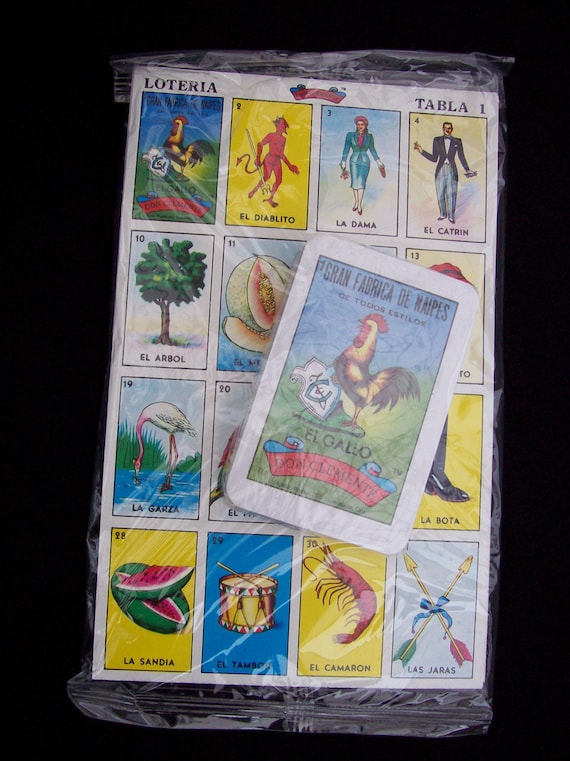
The deck a 'mere' bingo type card game common in Mexico is full of vivid images and riddles that evoke many meanings that are indicative of life. Sometimes I think of the riddles almost as little life lessons. Take La Chalupa for instance. (The Sloop, little boat) Rema y rema va lupita, sentada en su chalupita. The rules are similar to bingo in that players mark spots on a tabla, or board, with a token (traditionally a raw bean). And for the Mexican, Latinamerican / Latinx community, I hope that they.
| This is the talk page for discussing improvements to the Bingo (American version) article. This is not a forum for general discussion of the article's subject. |
Article policies |
| Find sources:Google (books·news·newspapers·scholar·free images·WP refs) ·FENS·JSTOR·NYT·TWL |
| Bingo (American version) has been listed as a level-5 vital article in Life. If you can improve it, please do. This article has been rated as Start-Class. |
| This article is of interest to the following WikiProjects: | |||||||||||||||||||||||||||||||||||||||
| |||||||||||||||||||||||||||||||||||||||
Opening heading[edit]
It has been proposed the this article be merged with Housie in Bingo. Please discuss here. (Please avoid confusing discussion by making comments about the merger only at Talk:Bingo (disambiguation). Madeinsane 00:52, 13 December 2006 (UTC)
Rules[edit]
These bingo rules are not the same as the bingo rules I am familiar with. Where I come from:
- The card bears a five-by-five array of numbers (or several such arrays), except for the middle cell, which is a 'free space'.
- The numbers range from 1 to 75. The left-hand column of the card has numbers in the range 1 to 15; the second column from the left has numbers in the range 16 to 30, etc. Above the columns are the letters B-I-N-G-O.
- Numbers are called as 'I-18', 'O-71', etc.
- The 'canonical' win is any row, column, or diagonal. However, variations are common.
The rules listed above appear to be the most common rules in the United States.
I added something about what I called North American rules, but which are really the rules in southern Ontario, which are the only rules I know, so if anyone knows better than me about American rules, please fix that part up. Trontonian 17:49, 1 Mar 2004 (UTC)
- I changed North American to Canadian and American. I have no idea what Mexican bingo is like. Trontonian
Mexican bingo is referred to as chalupa, and uses the same basic rules as for American bingo. However, the playing card is a 4X4 array, with images of simple items used instead of numbers. Images are such as 'El Catrin' (The Gentleman), La Botella (The Bottle), El Alacran (The Scorpion), etc. Images are called from a deck of card which contains 56 different images. This simpler set of possibilities allows for a quicker pace. Typically the winner of the round has the option of calling the cards for the next round.
- I think you're talking about Loteria. ~ trialsanderrors 22:11, 26 May 2006 (UTC)
Mechanised bingo, and basic rules[edit]
I've added a little about mechanised bingo and more about the rules of bingo. It would take a readjustment of the page to include all the major rules for bingo. Also I am only adding what I know from Working in the Bingo industry as a main stage caller, so all of my info is from UK bingo. If you want to know more or have any articles about bingo you want adding to just let me know.
Arlechinio 00:10, 4 Sep 2004 (UTC)
For Bingo calls, I seem to recall one '__ dozen'. Obviously if I could recal how many dozen, I would know which number...
Politically correct bingo sayings..?[edit]
Has the kill-joy PC brigade in the UK banned sayings, like 'two fat ladies' for the number 88?
- No, they still say it. Where did you get that from?--Jcvamp 19:03, 8 October 2006 (UTC)
- They don't say it in most commercial bingo halls in the UK, such as those owned by Gala Bingo, but this is mainly because of time efficiency, rather than political correctness. When it is played in church halls, social clubs and other similar settings, the nicknames are retained. There is a link between the use of an electronic RNG to generate numbers, and not using the nicknames. Madeinsane 19:58, 12 December 2006 (UTC)
Housie slang?[edit]
I realize that they are similar games, but should 'housie' slang be in the housie article instead?
- It seems to me that all variants probably ought to be in the same article, as they're not that different. — sjorford(talk) 15:28, 20 April 2006 (UTC)
- I would support the articles being recombined. The differences are too minor to justify separate articles. 2005 20:10, 20 April 2006 (UTC)
- There is a more extensive discussion on the talk:Bingo (disambiguation) page. Madeinsane 20:00, 12 December 2006 (UTC)
Online bingo[edit]
Is there online bingo in the U. S. or Canada? I left the bit about it in because I don;t know. I removed the references to Scandinavian games, though, because they're obviously not relevant. John FitzGerald 01:32, 14 December 2006 (UTC)
- Online bingo in the US does currently exist but soon may not. The online gambling industry worldwide has taken a big blow since the amendments to the Safe Port Act, passed by the US Congress in Fall 2006 and subsequently signed into law by the President. See this link and the main Online bingo and Online gambling articles. Madeinsane 15:01, 14 December 2006 (UTC)
History[edit]
Where and when did it originate?Andycjp 08:58, 24 October 2007 (UTC)
Etymology[edit]
is it useful to have an etymology for the term? I came to this article to check if my hunch was correct. I mean, I have no sources or anything, but it seems to me that 'bingo' comes from the Latin vinco, 'I win'. seems that Bs and Vs are pretty similar.... —Preceding unsigned comment added by 99.251.230.51 (talk) 16:28, 12 December 2007 (UTC)
Prostitution[edit]
Is this bit really necessary? It is at the least uncited, and at the worst a dumb joke. —Preceding unsigned comment added by 24.111.80.64 (talk) 23:42, 17 August 2010 (UTC)
I am removing it and placing it here if anyone can cite it. In any case, it doesn't belong in the lead.Jbower47 (talk) 18:21, 26 August 2010 (UTC)
- 'Bingo erupted on the prostitution scene in the 1980's when senior citizens would get together and play strip bingo.' —Preceding unsigned comment added by Jbower47 (talk • contribs) 18:22, 26 August 2010 (UTC)
Alleged WP:EL violation deleted from External links section[edit]
On 23 March 2011, Johnuniq removed the following link from the External links section:
Johnuniq's stated reason in the edit summary of his edit was 'per WP:EL'
I looked at WP:EL and don't see why the deleted link was deemed to be something that should be deleted. Could somebody explain this? Wideangle (talk) 19:27, 23 March 2011 (UTC)
Restore 'Defensive omnivore bingo'[edit]
On 24 June 2011, 129.125.101.92 removed the 'Defensive omnivore bingo' item from the External links section with the comment 'omnivore bingo has nothing to do with the number game this page discusses'. My response is that Defensive omnivore bingo is as closely related to standard bingo as the items listed in the 'Variations' and 'Other forms' sections. I am therefore restoring 'Defensive omnivore bingo' to the External links section. Wideangle (talk) 23:53, 27 June 2011 (UTC)
cm se juega eso??? nose cn quien juego ayuda xfa — Preceding unsigned comment added by 200.8.123.85 (talk) 04:07, 6 October 2011 (UTC)
Reference to Zynga[edit]
The page header contains information about the invention of the game in 1929 and it goes straight to... Zynga. I guess there are a GREAT number of versions of the game that are far more relevant than this one.This reference to a version of the game by a social network game company seems useless to me. — Preceding unsigned comment added by 173.177.173.92 (talk) 01:02, 4 March 2012 (UTC)
- It's actually useful. If you don't like it near the top of the article (this goes for any Wikipedian who sees this) please move it to an appropriate section. Georgia guy (talk) 01:06, 4 March 2012 (UTC)
A lot of things are useful. I think the question here was ethics. Many online game companies make Bingo. I found the reference offensive when I came to the page, so simply removed it. If you're looking for manufacturers of a game that's 500 y/o, that's what Google is for. Calling a spade a spade, and a conflict of interest just that- a COI. Ninavizz 08:20, 13 March 2012 (UTC) — Preceding unsigned comment added by Ninavizz (talk • contribs)
Other variation: Drive-in bingo[edit]
In Nova Scotia there is a drive-in movie theater that has a fun variation. Same rules, but you tune your radio to the frequency of the theater (as if you were going to watch a movie) and they call the numbers over the radio. You shout bingo by honking your car horn. — Preceding unsigned comment added by 190.238.86.148 (talk) 16:49, 7 January 2014 (UTC)
References[edit]
This page is one of a set of pages that need more references. It is a nice page but no references just a lot of possible half-truths. Started to add references and references are removed. Just going backwards in time? Add references or find better ones, don't remove references blindly. 15-20 sections and 5-6 references. How does anyone know this is not a lot of bs? One reference seems to be better than none. You need to start somewhere....Moving On... — Preceding unsigned comment added by 74.102.226.45 (talk) 00:06, 9 September 2014 (UTC)
- You added a reference to one church game to support the statement that church games 'are normally weekly affairs held on the church premises' throughout the country.[1] The source does not demonstrate anything of the kind. We can equally support that Christians in the U.S. normally picket the funerals of anyone even remotely connected to LGBT rights or that restaurants in the U.S. typically serve fried peanut butter/bacon/banana sandwiches. - SummerPhD (talk) 01:53, 9 September 2014 (UTC)
Electronic Bingo[edit]
Class II machines are typical called Bingo machines because of the software structure, but these games look like a regular slot machine. Where Electronic Bingo or Video Bingo should refer to an electronic video bingo game, where you can play bingo electronically. Maybe there is a better way to post this. --Edelg003 (talk) 22:24, 15 December 2014 (UTC)
He went on to copyright 'Bingo'[edit]
'He went on to copyright 'Bingo' ... what is this claim supposed to mean? Nobody copyrighted the word 'Bingo'. A word can't be copyrighted. This appears to be an unsupported claim, and it doesn't correspond with the fact that 'Bingo' cannot be copyrighted. — Preceding unsigned comment added by 139.68.134.1 (talk) 16:21, 18 June 2015 (UTC)
Article fails[edit]
Mom (an inveterate Bingo player) asked me how the game came about, and what the actual chances of winning are for various games. I recommended Wikipedia, and she found the article disappointing, a sentiment with which I agree. So, a few open questions:
Why 25 spaces? In particular, why five columns of five numbers? Why the central 'free' spot?
The statistics ought to be laid out more completely, rather than just dumping some (unexplained) stats math & a Really Big Number on readers. Spell it out in English! How many five-number sets are possible in each column? How many variations of each set are possible? Similarly, how many collections of 24 numbers could in theory exist without repetition? and how many variations can appear of those same 24 numbers?
It boggles me somewhat that carnivals could have produced these cards themselves back in the 1920s. At the same time, in modern times I can't imagine how it is that these randomized layouts of randomly selected numbers can be so readily printed.
John Scarne addressed Bingo cheating. How is card production audited? Are there laws that regulate this? What sorts of controls are used on the cards to prevent someone from smuggling in their own cards?
There are parlors that don't 'read back' the numbers to verify a winning combination, instead calling out (as in the U.K. version) a security code printed on the particular card that somehow validates that the card does indeed contain the numbers that have been called to achieve that combination. How the heck (briefly) does THAT work?
Some years back, Paul Harvey presented a long The Rest of the Story segment where he talked about a wealthy man who hired a renowned mathematician to produce these randomized collections of numbers, one after the other, and worked him hard for years, paying very well but eventually driving the mathematician into a lunatic asylum. Given the gazillions of possible cards, this seems somewhat unlikely but it stuck in my head & is possibly still floating around somewhere as an urban legend, particularly if it was included in either of the volumes collecting Harvey's tall tales.
Weeb Dingle (talk) 18:17, 13 January 2019 (UTC)
Numbers at top of page[edit]
What do the numbers at the top of the bingo game mean and what do you do with them
Dee — Preceding unsigned comment added by 2600:8807:2100:6B1:ADAF:DD01:5036:2FCB (talk) 07:24, 25 March 2020 (UTC)
Alan Dale Hansen
Carroll College USAKelly Miller Quintanilla
College of Liberal Arts at Texas - USAAbstract
Much of Intercultural Communication (ICC) scholarship is interested in the 'intercultural encounter': interaction between people who are from different cultures. Taking culture to be emergent in social interaction, in this paper we examine group interviews about health and diabetes which were conducted in the Southwestern U.S. with Hispanic adults. Using discourse analytic methods, we show how culture emerges in these group interviews, as participants treat objects (practices, etc.) as cultural in the performance of interactional tasks such as explaining, account-making, and managing face-threat. Analysis reveals that close analysis of the emergence of culture in interaction may help ICC scholars enter interdisciplinary discussion of effective health care delivery in an increasing culturally-diverse and culturally-complex world
Keywords: culture, social interaction, diabetes, group interviews, Hispanic.
Introduction
Intercultural Communication (ICC) is the study of heterophilous interpersonal communication between individuals of different cultures. ICC focuses on the interpersonal interaction of people who represent different cultures. (Rogers & Hart, 2002, p. 2; italics in original)
The paragraph given above is typical in Intercultural Communication (ICC) in a field defined largely by difference. Because the typical definition of ICC (as illustrated above) is tautological, investigation of the phenomenon of intercultural communication must first clarify both 'culture' and 'communication' (Barnett and Lee, 2002). In the United States, ICC was established to teach American dignitaries enough about the respective (national) cultures to which they were assigned to help them to function effectively. Consequently, in the U.S., ICC has a heritage in very practical aspects of communication study (see Leeds-Hurwitz, 1990b). More recently, a number of notable ICC scholars – such as Carbaugh (e.g. 1990), Casmir (e.g. 1999), Gudykunst (e.g. 1997), Hofstede (e.g. 2001), Kim (e.g. 2001), Philipsen (e.g. 2002) and their associates – have done what Leeds-Hurwitz (1990b, p. 262) calls 'an elaboration of theory.' Today, ICC scholars inherit a seemingly diffuse discipline with a wide array of theories and approaches oriented to the principle and research finding that the nexus of 'culture' and 'communication' – moments in which these two phenomena intersect – is worthy of investigation.
Despite disciplinary tensions in regard to how 'culture' and 'communication' are conceptualized and investigated,[1] we propose that there are common points of departure in ICC research. There are shared questions to which all ICC inquiry is bound, including: Where does intercultural communication take place? (see Barnett and Lee, 2002) and What is the relationship between culture and communication? (see Hall, 1959; Leeds-Hurwitz, 1990a). These questions are fundamental to ICC scholarship, particularly because so many disciplines engage 'culture' and 'communication' as veritable phenomena.
In this paper we answer the questions posed above with an examination of group interviews with Hispanic adults about health and diabetes. Recently, scholars in the social and medical sciences have answered a call to investigate why people of Hispanic[2] descent in the U.S. are disproportionately affected by type 2 diabetes mellitus, one of the most rapidly-increasing, most costly and most burdensome chronic diseases of our time (King et al., 1998). This issue provides for a suitable case-in-point of the need for careful analysis of culture, communication and intercultural communication where members of 'significantly different' cultural groups come into contact (see Barnett and Lee, 2002, p. 276).
Two findings related to type 2 diabetes make culture relevant. First, studies consistently show a prevalence of diagnosed diabetes alarming enough to suggest that diabetes is an epidemic among Hispanics (Umpierrez, et al., 2007), including Hispanic children (Crawford, et al., 2001). Second, the proven close association between diabetes and obesity, generally caused by poor nutrition and physical inactivity (Kaufmann, 2006), leaves the door open for connecting diabetes to culture, alternatively cast as 'environmental' factors (Umpierrez, et al., 2007) or matters of 'lifestyle' (Tuomilehto et al., 2001). Because 'complex layers of meaning accompany all our conversations about health, wellness, illness, and medicine in cultural communities' (Geist-Martin, 2003, p. 63), scholars in medicine, humanities and social sciences appear to agree, generally, that patients’ culture (construed broadly) must be considered in research on diabetes. Difficulties in preventing, diagnosing and treating diabetes are widely acknowledged (see Purnell and Paulanka, 1998; Oomen, Owen, and Suggs, 1999; and Spitzberg, 1999) and culture is widely considered a barrier to diabetes prevention and treatment among Hispanics (see Aranda, et al., 2004; Packer, 2007).
Accordingly, this overwhelming interdisciplinary emphasis on culture as a factor in diabetes, along with a need to understand culture in efforts to prevent and treat diabetes, warrant careful analysis of the occurrence of 'culture' in discourse related to health and well-being among Hispanics. Taking culture to be a shared system of shared symbols and resources (Sanders, 1999; Hall, 2005), in this paper we employ an analytic approach equipped to identify and analyze the emergence of culture in social interaction. We proceed by discussing our approach to these data and then by examining moments in group interviews where participants appear to treat objects (practices, beliefs, people, etc.) as cultural. It is our hope that the analysis and discussion presented here are useful not only in future ICC research but also to cross-disciplinary research on the influence of culture on the prevention and treatment of diabetes among Hispanics in the U.S.
Discourse approaches to culture:
Culture and intercultural communication as emergent in social interaction
The question posed above – Where does intercultural communication take place? – suggests any number of answers. One such answer will be elaborated here: the intercultural encounter. A reading of ICC work including popular texts used in teaching intercultural communication to undergraduate and graduate students in the U.S. and elsewhere, shows that the ICC field is captivated by the intercultural encounter. Intercultural communication occurs where folks from different cultures interact – not only in specialized locales such as national borders, ports of entry, seaports, international airports, tourist destinations, but also in mundane corporate, social, community, educational and government contexts (Hofstede, 2001; Barnett & Lee, 2002). An increasingly diverse world means intercultural encounters are increasingly commonplace. Interaction between people is a constituent feature in all intercultural encounters. These interactive moments are sometimes profound and sometimes mundane, but all such moments are consequential to ICC scholars because they occur where culture and communication converge. Accordingly, we might adopt an analytic orientation equipped to locate and examine culture in the ebb and flow of social interaction.
According to Scollon and Scollon (2004, p. viii), moments of social action both enable and alter 'historical trajectories of people, places, discourses, ideas and objects.' Privileging the moment in intercultural encounters thus means finding analytical footing amid 'naturally occurring events' (Schegloff, 2005, p. 456). However, analyzing social life at the nexus of communication and culture is as treacherous as it is integral to ICC inquiry: On one hand, such an enterprise is replete with unanswerable questions (Schegloff, 2005), inherent problematicity (Fitch, 1994), and unattainable propositions (Sanders, 1999) for most conceptualizations of culture. On the other hand, 'communication practices' are 'situated within cultural worlds' (Fitch, 1998, p. 91), just as culture bursts onto the scene 'only in the service and performance of occasioned tasks' (Moerman, 1993, p. 94). Because of this difficulty, a common approach in ICC inquiry is to constitute, in a priori fashion, participants as being 'from' or 'members of' a given culture.
A number of ICC scholars have engaged the question, where does intercultural communication take place? by actively resisting a priori constitution of participants in an intercultural encounter as members of a culture. This work upholds the notion that culture, identity and membership are inherently problematic for participants in any given encounter (Moerman, 1993; Antaki, Condor, and Levine, 1996), thus treating 'culture' and 'intercultural communication' as emergent in interaction – in that whether or not the interaction is 'intercultural' is contingently relevant to participants and analysts. As a preface to examination of moments in group interviews where participants treat objects (beliefs, practices, etc.) as cultural, we briefly review three analytic approaches – culturally-contexted conversation analysis, cultural discourse analysis, and interculturality. These approaches are related in that each orients to 'culture' and 'intercultural communication' respectively, as an emergent (rather than a priori) feature of social interaction.
The first approach is culturally-contexted conversation analysis. Starting under a 'view of culture as internal to action' (Hester and Eglin, 1997, p. 153; italics in original) and that 'talk is thoroughly and multifariously embedded in the historical, cultural, social, biographical … context of its occurrence' (Moerman, 1988, p. 8), culturally-contexted conversation analysis examines the sequential organization of talk. This is because talk instantiates, for participants as well as analysts, 'the processes and the problematicity of culture' (Moerman, 1988, p. 5). Analysis of talk-in-interaction includes searching for the structures participants invoke as they 'actual situated talk meaningful for its talkers' (Moerman, 1988, p. 6). Moerman (1988, 1993), whose work illustrates (and provides a ready lightning-rod for[3]) culturally-contexted conversation analysis, articulates it this way:
Much of our social life consists of talk organized as conversation with which we conjure up and deal with our fellows, expose our character, bespeak our culture. Conversation analysis provides a technical description of how that talk is organized. From this we can each see and use what we will: sometimes placing some object of scholarly interest … in the context that gave it its local meaning, sometimes using the structure of conversation as natives to: to hook, display, articulate, and fashion things out of the web of culture. (1988, p. 29)
In general terms, then, culturally-contexted conversation analysis combines ethnography and conversation analysis (a form of micro-oriented analysis of social interaction) (see Moerman, 1988). This combination brings culturally-contexted conversation analysis in line with ethnography of communication in both principle and practice, and places emphasis on how communication is shaped by participants as a cultural practice– that is, 'what people in particular places make of communication when practiced in their own way, when understood through their own terms, through their own explanations' (Carbaugh, 2007a, p. 168). Emanating from Dell Hymes’s pioneering work in linguistic anthropology (Gumperz and Hymes, 1972; Philipsen and Carbaugh, 1986), ethnography of communication facilitates innovative, detailed analysis of culture as it emerges in and through communication practices – for instance, joking (Basso, 1979), complaining (Katriel, 1986), and giving directives (Fitch, 1994). Donal Carbaugh and his associates recently have synthesized and given programmatic clarity to cultural discourse analysis, a second analytic approach. Carbaugh (2007a, p. 174) puts it this way:
[A]s people communicate with each other, they are saying things literally about the specific subject being discussed, but they are also saying things culturally, about who they are, who they are related, what they are doing together, how they feel about what is going [on], and about the nature of things. These cultural meanings – about personhood, relationships, action, emotion, and dwelling, respectively – are formulated in cultural discourse analyses as 'radiants of cultural meaning' or 'hubs of cultural meaning' which are active in communication practice.
In cultural discourse analysis, examination of culture is most fruitfully done when analysis – which includes observation and selection of phenomena of interest as well as reflection on and interpretation of these phenomena (Fitch, 1994) – is fastened to, and grounded in, situated interaction. In analysis of interculturality, a third approach to discourse analysis which orients to culture and intercultural communication as emergent in interaction, particular emphasis is placed on moments in which participants themselves treat a given encounter as intercultural in nature. Interculturality work not only orients to culture and intercultural communication as emergent in social interaction, but also holds the analyst accountable for showing how participants themselves invoke, or talk into being, the intercultural encounter. This approach thus takes the strongest stance against taking for granted culture and cultural differences in studying intercultural communication. Aug Nishizaka (1995, p. 303), whose work on the interactive constitution of interculturality occasioned some subsequent work in this vein,[4] relates interculturality to the stance of ethnomethodology vis-à-vis 'traditional' sociology:
This cannot but remind me of a complaint Harvey Sacks made about the procedures of traditional sociology: It has not dealt with 'real phenomena.'[5] In order to approach such 'real phenomena,' I want to show how it is that interculturality – cultural differences between the participants – is relevant to or in the very communication that can be called 'intercultural.'
Using excerpts from radio program interviews conducted with 'foreign students' in Japan, Nishizaka (1995) shows how the host’s 'Japanese-ness' and the guests’ 'foreign-ness' are contingently relevant, and interactively constituted and accomplished, in identity and language-ownership claims occurring in repair sequences, discovery markers, and the like. Subsequent work in analysis of interculturality explores how cultural differences between Japanese and American students are accomplished by participants through conversational interpretation moves (Nishizaka, 1999), how Japanese and American interactants use cultural differences as a resource for organizing participation in multi-party talk (Mori, 2003), and how nonnative-speaker and native-speaker identities are constituted, occasioned, invoked, and negotiated in social interaction (Park, 2007).
Each of the three approaches discussed above treats culture and intercultural communication as emergent in social interaction, and resists constituting participants as members of a given culture prior to analysis. Accordingly, these approaches provide resources for close examination of moments in which participants in group interviews on health and diabetes treat objects (beliefs, practices, etc.) as cultural, including moments featuring emergent (cultural) differences.
Data and Methodology
Data examined for this study are group interviews conducted as part of a multi-method study of socioeconomic and sociocultural aspects of type 2 diabetes mellitus among Hispanics in a midsized city in South Texas.[6] A total of four hour-long, semi-structured group interviews were conducted by two co-authors, as part of a larger study. Each interview lasted about one hour and included 7-9 participants. (See Appendix A for a schedule of questions.) Facilitators encouraged exploration of emergent topics with follow-up questions and prompts, and facilitated interaction among participants themselves.
Methodologically, the interview is considered a species of naturalistic interaction in qualitative research (Lindlof, 1995; Berg, 2004) and discourse analysis (Silverman, 1985, 1993; Holstein and Gubrium, 1997). The interview is problematic in that it is characterized by asymmetry (Baker, 1997) and specialized turn construction and allocation (Clayman and Whalen, 1988/89), which place consequential restrictions and qualifications on participants (Button, 1987; Heritage and Roth, 1995; Nofsinger, 1999). However, the interview encounter nonetheless is valuable as a 'special form of conversation' in which participants’ interpretive reasoning practices potentially are manifest in discourse (Holstein and Gubrium, 1997, p. 113).
Group interviews are similar to individual interviews. However, group interviews carry the potential for interaction between group members (Berg, 2004). The group interview setting thus is particularly useful because in addition to featuring coordination as social interaction in any setting would, the group interview also facilitates in particular the occasioning and making of accounts (Goffman, 1967) and displays of perspectives and cultural logics (Baker, 1997). These activities are a site for the emergence of culture and interaction. Consider:
It is when persons, relationships, and episodes are subject to being evaluated, are evaluated by the participants themselves or by others in the community for what the participants opt to say or not say, and how they said it, in interactions – within what would be coherent, commensurate with their activity and with their wants – that we come face to face with culture. (Sanders, 1999, p. 138)
Accordingly, the group interview facilitates opportunities for participants to treat objects (practices, beliefs, etc.) as cultural, which in turn allows us to examine the emergence of culture in social interaction. The close analysis of social interaction featured here, orienting generally to 'how people in society produce their activities and make sense of the world about them' (Pomerantz and Fehr, 1997), resonates with subfields in Language and Social Interaction (LSI) work, which is interested in 'the meaningfulness of interactions and … how interactions comprising such details of language, sequentially organized in that way, involving those participants in that setting, have the interpersonal, institutional, or cultural meaning they do' (Sanders, 2005, p. 5). This paper thus connects to work in ICC and LSI insofar as these disciplines share an interest in examining communication from a cultural standpoint (Philipsen, 2002), which shared interest is evident in a burgeoning body of literature that finds its place in both disciplines.[7]
Data Analysis
In this section we analyze interaction between participants (including the facilitator) in group interviews, attending in particular to moments in which participants treat objects (practices, beliefs, etc.) as cultural. Anticipating the outcome of this examination, analysis reveals the following. First, to treat a given object (such as a practice) as cultural is to do more than merely refer to typically-cultural objects (such as practices). Second, participants treated objects (including practices, selves and others) as cultural by linking them to a delimited category or group. Third, connecting cultural objects and group membership served as a resource for participants in creating shared understanding and in performing interactional tasks such as account-making and managing face-threat.
As we interact with others, we routinely make reference to aspects of our lives that might be construed as cultural, that are 'typically cultural,' in the sense that these aspects of our social and personal lives are integral to the shared system of symbols and resources of a bounded group. Aspects of life typically treated as 'cultural' include pastimes, interests, family life, foods, eating habits, and so on. A cursory look at the schedule of interview questions (Appendix A) reveals that the interviews are littered with references to such typically-cultural features of people’s lives,[8] although there is variation in how such features are treated once invoked.[9] Consider Extract 1.[10]
Extract 1 (FG2, 25 January 2007, lines 242-260)
M2:Everybody- that sounds like fun. Ac(h)t(h) hehe okay other things you do::? at- at activities you- you mentioned- you [know
Richard: [We:ll if I go to my mo:m’s out the:re, (.) we barbecue out the:re (in-) at her ra:nch and (0.7) everybody wants to get on the horses so we end up- saddling up the horses and .hh (everybody) [watching (people) fall off ]
M2: [Yeah- and you put- and ride the horses?]
Richard:yeah [(watch them fall off a them)
M1: [(h) hehehehe .h
(.)
Jose:Sometimes (they’ll) bring the piñata and (0.2)
M2:And you do the [piñat-
Jose: [And- e- even though it’s not a birthday (0.2) just for fun. You know.
Richard:Just to break it.=
M2: =Yeah, ^ okay, ^^ good
Prior to this extract, M2 has asked participants what sorts of things they do on weekends (as participants had reported that they spend weekends with family). M2’s prompt in lines 1-2 includes: a response to participants’ prior reports ('that sounds like fun'), a search for additional activities ('Okay other things you do?'), and the beginning of what could have become a candidate list of activities that were mentioned prior ('activities you mentioned you know'). M2 thus accomplishes a prompt to which Richard (lines 3-6, 8, 15) and Jose (lines 11-13) respond.
In addition to the implicit practice of spending weekends with (what some call 'extended') family, in this extract Richard and Jose refer to practices including barbecuing, riding horses, and breaking a piñata. These are produced as practices in response to the prompt, and are candidate cultural practices. In fact, some of these activities are widely considered to be typical Mexican/tejano cultural practices. Yet Richard and Juan do not treat these practices as cultural per se, even in the face of two substantive-recipient responses (Waring, 2002) by M2 (in line 7 and again in line 12) which occasion some elaboration these practices.
The substantive-recipient responses merit a closer look. First, following (and coinciding with) Richard’s discussion of saddling up horses, M2 asks if they 'ride the horses' (line 7). Richard displays having heard the question ('yeah' in line 8) and then appears to repeat the part of his discussion that coincided with the prior question, but does not elaborate. The second instance of substantive recipiency is more telling. Here, Juan reports the presence in family gatherings of a typically-cultural artifact – the piñata – and a related set of typically-cultural practices. Not only is the piñata a standard-bearer of Mexican (and related) cultures, but the term 'piñata' itself, which requires that the speaker transfer to Spanish to name it, presents itself and practices related to it as cultural. Jose’s report of bringing the piñata is followed by a formulation by M2 ('And you do the piñat-,' line 12). By formulating the report, M2 treats bringing a piñata as an accountable action (Sacks, 1995) and brings into being a sequential environment which seems to occasion elaboration or justification (Antaki, 1994, 1996) of bringing the piñata. Both speakers oblige, in a way: First, Jose, who displays his understanding of an apparent concern motivating M2’s question (that the piñata is generally part of a birthday celebration), by saying that they bring a piñata 'just for fun' (line 13). Richard collaborates with Jose’s anti-elaboration account, with 'just to break it.' This collaborative 'just-because'-type account stops short of treating the piñata as cultural, and instead treats it as the product of a non-systematic whimsy.
Thus the piñata, a typically-cultural artifact, that is, an artifact typically related to Mexican (and related) culture, is treated in Extract 1 by the respondents as nothing of the sort. In contrast, in Extract 2 participants treat the practice of drinking at a barbecue as cultural by binding the practice to a delimited group.
Extract 2 (FG1, 25 January 2007, lines 222-259)
M1:Ahm (0.5) .pt .h Describe the average weeke:nd, what’s it’s like,=and we’ve talked a little bit- with extended family coming over,=with family (0.2) ah:, what’s an average? weekend like for your family.
(2.0)
Marta:Oh (0.5) my weekends are basically the sa:me, you know, Friday ni::ghts it’s .hh p- ah:, popcorn, pickle and a movie with my- my ki:ds, just me and- my family, [which is my husband and my girls, .hh and the:n, you know
M1: [hmhm?
Marta: Saturday it’s- ge- it would be get together with the (0.7) family, (0.2) barbecue, and Sunday would be: probably the menudo because everybody’s (0.5) from a hangover.
M1:ha[hahahaha
Alfonso: [hahahaha ((also others))
M1:Okay.
(0.5)
M1:Okay so:-
Marta:But I don’t drink that much [he he
M1: [So- wha- when you get together on the- on the Saturday there’s also (0.5) eh- with the barbecue there’s also alcoho:l (1.0)
[that’s involved there.
Marta: [Yes.
M1:Okay.
(.)
M1:.h Would [you say the same thing Alfonso? [(or y- or)
Alfonso: [Yeah tha-) [Yeah it’s just- I mean, as- as far as I- I kno:w, or as far as I think that’s pretty much every (1.2) Hispanic [barbeque.
Edith:[Even a- yeah even a kid’s birthday party [(and there’s bee:r)
Alfonso: [yeah (and)
((laughing; participants, including M1, laugh in lines 28-31))
Alfonso:(Yeah I kn-) at a birthday party the kids are getting- havin fu:n and the parents are getting drunk, you know what I mean, [it’s (1.0) it’s all in the fu:n so
M1: [okay
M1:Yeah.=
Kaitlyn:=I:t, depends on my husband’s schedule …
This extract begins with a request by M1 that the participants 'describe the average weekend' with family (lines 1-3). After a considerable gap (line 4), Marta outlines a series of activities partitioned by the day on which they occur: a movie with her husband and girls on Friday (lines 5-7, 9); a barbecue with family on Saturday (lines 9-10); and menudo and a hangover on Sunday (lines 10-11).
Of particular interest to the participants (particularly M1) are descriptions of Saturday and Sunday. Marta’s description is greeted with laughter on the part of M1 and another participant (lines 12-13), followed by a continuer ('Okay.') by M1 (line 14). After a short gap, M1 produces the beginning of what could be a formulation of prior talk.[11] However, M1 is interrupted by Marta, who redresses a hearable implication of Marta’s prior talk by reporting that she does not 'drink that much' (line 17). Insofar as Marta’s redress of her implicated drinking behavior functions to treat the reported weekend activities as accountable, then M1’s reformulation continues, even upgrades, Marta’s accountability. M1’s reformulation is hearable as an attribution that for Marta and her family, barbecuing and drinking go hand-in-hand. Marta grants the attribution (line 21). With 'okay' (line 22), M1’s acknowledgement of Marta’s response provisionally completes the account sequence (Buttny, 1993).
However, Alfonso continues the account sequence;[12] his contribution is particularly important for showing how the participants treat the practice of drinking-while-barbecuing as cultural. At the point where Marta has acceded that her family barbecues and drinks substantially on Saturdays, Alfonso locates the practice of drinking-while-barbecuing as a 'Hispanic' practice – that is, a practice associated with a delimited group (with 'that’s pretty much every Hispanic barbecue,' lines 25-27). This treatment of the practice softens the attribution (and implication) toward her family, to which Marta had just acceded, by broadening the field to which this practice applies: Whereas discourse before lines 25-27 treated this practice as a feature of Marta’s family, Alfonso proposes, as an alternative implication, that the practice be treated as belonging to a more expansive (cultural) group.
Alfonso shows care in associating the practice to the group by: positioning the association as within the purview of both his knowledge and opinion, softening the extreme formulation including 'every' with 'pretty much,' and pausing before producing the category label 'Hispanic' (all in line 26). The complexity of Alfonso’s attribution marks it as ingroup – a characterization made by a member of the group being characterized – while the pause before 'Hispanic' suggests trepidation in engaging a loaded discourse. More importantly, Alfonso treats the practice of drinking-when-barbecuing as cultural by binding it to a delimited group ('Hispanic'). Alfonso’s characterization thus goes beyond simply referring to typically-cultural practices (etc.), but recognizably constructing the practice as part of the (named) group’s way of being. Alfonso’s characterization is welcomed enthusiastically through general laughter (referred to in line 30) and Edith’s elaboration of the practice (line 28).
In Extract 2 Alfonso and others treat drinking-while-barbecuing as a cultural practice for the apparent purpose of mitigating face-threat for Marta. In other moments in the group interviews, participants located objects as cultural in order to facilitate coming to a shared understanding. This is illustrated in Extract 3 below.
Extract 3 (FG2, 25 January 2007, lines 125-146, 206-232)
Jose:The- the thing that bothers me is
[tha:t (1.5) ] the thing that bothers me that- all
Angela: [Yer me- yer messed u:p or nothing]
Jose:Hispanics er (1.0) are labeled like (0.5) that’s all they do.
(1.2)
Jose:Barbecue and (.) and, drink. (That’s) not ^ i:t.
(1.5)
Jose:You know (.) I- I- I- I don’t like to be labeled eh-.
M2:Okay.
Jose:You know (.) we- we do it because (0.7) we have fu:n but (1.2) you know I- I’ve (0.7) we’re so stereotyped (1.0) that they say (1.0) Mexicans (.) or Hispanics or whatever (0.7) all they do is drink and have beer (0.5) and- and- I mean drink and- and- and, have barbecue. .h That’s not i:t, we have fu:n, we play Bingo you know [.hh
(Many): [yeah
M2:Yeah that’s what- that was my next question, what else do you [do? So, okay,
(Many): [((talk))
M2: [so you play Bingo:: ] .h you guys got-
Jose:[I- (.) I’ve never drank in my li(h)fe.]
… ((discussion continues with Jose attempting to topicalize stereotyping and meeting what appears to be some resistance in turning the discussion toward this topic))
Jose:So- so you know- I’m (the) (0.2) I’m the [type of
M2: [Se-
Jose:person that will keep back- or [(.) or, stay ba:ck,
M2: [okay
Jose:[I’ll tell you. ]
M2:[So you s- (.)] And you said you play- you like to play Bingo: and ga:mes when you guys get together.=Are there other things you guys do? Do you things like tha:t, any kind a recreational [thi:ngs?]
Eugenio: [Ah:, ] we play: (.) ah- well- we play like ah: hh Mexican Chalupa?
(0.5)
M2:How do you play that?
(.)
Eugenio:Ah, Loteria.
(1.0)
M2:[I’ve never-]
Eugenio:[It’s ah, ] they ah- you just match the- you have the cards and you
match the na- the (0.2) [pictures?]
M2: [Oh:: ] it’s a card ga-, oh okay, okay.
(1.0)
Robert:It’s like a Mexican Bingo.
(0.5)
Eugenio:[Yeah
M2:[Okay. ^ Good- other things …
This extract begins (lines 1, 4, 6) with Jose offering a complaint (prefaced as such, 'the thing that bothers me is,' lines 1-2) about a stereotype associated with (in this case) Hispanics, that 'all they do' is 'barbecue and drink' (lines 4, 6). Notably, Jose does not treat the stereotype as untrue (in fact he concedes truth in it, with 'we do it because we have fun,' line 10), but rather argues that these activities do not, by themselves, offer a complete description of the group. Jose then offers activities in addition that encapsulate the group: 'we have fun, we play Bingo you know' (lines 13-14). This sequential placement – as another in a list of what it means to be Mexican/Hispanic – positions 'Bingo' as a candidate typically-cultural activity. M2 initially selects 'Bingo' and prompts Jose about it (line 18), and returns to Bingo later on (line 86) amid questions about other recreational activities (lines 87-89). By offering 'Mexican Chalupa' in response (lines 90-91) – the Spanish term 'chalupa' prefaced by 'Mexican' as a categorical modifier – Eugenio locates this practice as bound up with a Mexican-type group. By asking how it is played, M2 treats the practice as unknown (foreign, in a way); in response, Eugenio offers what appears to be another name for the activity; implicated in the one-second pause is that the alternative name does not clarify the matter for M2. Accordingly, just as M2 begins what appears to be an account of the silence (perhaps that she’s never heard of the game) Eugenio offers a second attempt by describing the game (lines 96-97).
Although M2 displays understanding, offers a reformulation (it’s a card game), and treats the matter as settled (okay, okay) (line 100), the other participants do not appear to treat the matter as settled. This is evidenced by the one-second pause following the reformulation (line 101) – where some acknowledgement of M2’s reformulation might close up the embedded sequence (see Waring, 2002) – and a third attempt at describing the activity, offered by Robert: 'It’s like a Mexican Bingo' (line 102). This serves as an attempt to bridge the gap in understanding evident in the interchange between M2 and Eugenio. In describing it this way, Robert draws on M2’s apparent understanding of Bingo while upholding the differences between M2’s (assumed) understanding on one hand, and the alternative names and descriptions offered by Eugenio on the other. Cultural difference emerges in the interaction; treating the activity in question as cultural serves Robert as a resource to bridge a gap in understanding and to facilitate closing the sequence.
Culture in Work on Health and Diabetes:
Emergent? Occasioned? Omnirelevant?
Up to this point, we have shown how participants treat objects (practices, beliefs, etc.) as cultural in performing interactional tasks, such as account-making and managing face-threat, and in creating shared understanding. In analyzing these group interview data, we observed (with great dissatisfaction, at least at first) that a number of cases in which participants treated objects as cultural appeared to be occasioned by the facilitators. Consider Extract 4, where the shape of M1’s question prompts an apparent search for typically-cultural foods.
Extract 4 (FG3, 25 January 2007, lines 131-161)
M1:What traditions do you have in your families (1.0) that have- (.) come alo:ng through generations.=Do you have any family traditions? .h Like recipes would be an example but there’re all s- all sorts of different- sorts of traditions.
(1.5)
M1:Anything come to mi:nd?
(5.0)
Adam: Only, ah:m
Beatrice: Tamales?
(1.0)
Nelda:hmhm
(.)
Nelda:[Tamales ((3 syll.))
[((laughter))
Denise:(And those- what are tho:se)=
Beatrice:=and those (tornea:s) with-
Mary:quinnuelos?=
Nelda:oh:
(.)
Nelda:[oh
Beatrice: [And the pan de pollo:s.
(1.0)
Nelda:Polv(h)o haha[haha
Beatrice: [Whatever they’re called I do(h)n’t (.) you know what I mea:n though!
(2.0) ((laughter))
Beatrice:Pan de pollos, whatever they’re ca:lled.
(1.0)
Beatrice:Cookies.
((laughter))
M1’s question (lines 1-4) occasions a search for culture by foregrounding 'family traditions' and by compounding this with the suggestion that foods – a typically-cultural element of communal life – are a place to locate these traditions. Participants appear to experience difficulty in answering this question, initially. This is evidenced by a substantial pause (line 5), a prompt (line 6), and a second substantial pause (line 7). This extract is characterized by uncertainty (line 15, 17) as participants collaboratively search for 'relevant' responses. This uncertainty includes a mistake in characterization ('pan de pollos,' line 21) which is ridiculed (lines 23-26, 30) and reformulated (lines 27, 29). The defining feature of this stretch of talk is that the participants’ discourse – including the search through typically-relevant foods – is occasioned by the question. By asking this question in this way, M1 talks culture into being – by consequence if not by design – and they who are expected to answer the question attempt to oblige.
The palpable occasioning of culture in Extract 4 calls into question group interview data in examining the place of culture and cultural difference in discourse on diabetes, health, and well-being. Studying the emergence of culture, where elements of culture are occasioned, may be problematic. However, no less problematic is the omnirelevance accorded to 'culture' in studies of minorities and diabetes: To be Hispanic (etc.) is to possess cultural beliefs and qualities that (always and inevitably) undermine the delivery of health care. While space limitations preclude a detailed review of the immense literature which treats culture as a barrier to effective treatment, the following (from a recent article calling for increased cultural sensitivity in treating Hispanics for diabetes mellitus and related illnesses) is typical:
Like in any racial or ethnic group, the Hispanic culture is rich in fascinating traditions, beliefs, practices, and attitudes that influence the perception and understanding of disease processes as well as their treatment. A lack of understanding and sensitivity to these issues may create barriers rather than opportunities to provide high-quality diabetes care. At the same time, creating a stereotype about Hispanics is as erroneous and dangerous as not recognizing those cultural factors that may influence diabetes care. Improving our cultural competence in interacting with patients from diverse backgrounds is an explicit demand in a multicultural society like that in the United States. (Caballero, 2005, p. 222)
In the literature on Hispanics and diabetes, culture (often conflated with ethnic heritage and nation-of-origin) is treated as omnirelevant, that is, as always and inevitably present and consequential. Accordingly, in a sense similar to the manner in which M1 occasions 'culture' in the group interview, research and discussion related to Hispanics (& etc.) and treatment of diabetes also occasions culture and cultural difference by treating culture as a stable and omnipresent characteristic. In this paper we suggest a more careful orientation to 'culture,' 'cultural difference' and 'intercultural communication.' This orientation includes treating phenomena as emergent, and resisting a priori constitution of people (e.g. patients) as finally and inevitably 'cultural.' This approach may help ICC scholars whose inquiry strikes at the nexus of culture and communication – the very province of ICC scholarship – as we seek to enter interdisciplinary discussion of effective delivery of health care in a world that is not only increasingly culturally diverse, but is also increasingly complex in regard to culture.
Notes
1 Loosely framed, this tension relates to whether or not culture and cultural difference are assumed to be related to other organizing phenomena such as race, ethnicity and nation-stateand how the occurrence of culture (and cultural difference) might best be investigated. This tension has sometimes been cast as etic/emic (Casmir, 1999), micro/macro, and quantitative/qualitative (Leeds-Hurwitz, 1990a), and is rarely engaged directly (but for notable exceptions see Casmir, 1999; Hall, 2005). A comprehensive review of this disciplinary tension is outside of the scope and limits of this study.
2 In the United States, the term 'Hispanic' is a panethnic term conventionally used to classify persons whose ethnic heritage is related to Spanish-speaking regions in the U.S., Spain, Mexico, Central and South America, and the Caribbean.

3 Shortly after publication of Moerman’s book, Talking culture: Ethnography and conversation analysis, a special section of the journal Research on Language and Social Interaction was dedicated to responses by ethnographers, conversation analysts and those in-between (see Hopper, 1990/91a). Some essays supported and extended Moerman’s findings, while others were critical of his work.
4 See Nishizaka (1999), Mori (2003), and Park (2007).
5 Here Nishizaka refers to this oft-quoted excerpt from a published lecture by Harvey Sacks (1995, pp. 41-42): 'All the sociology we read is unanalytic, in the sense that the simply put some category in. They may make sense to us in doing that, but they’re doing it simply as another Member. They haven’t described the phenomena they’re seeking to describe – or that they ought to be seeking to describe.'
6 We are grateful to the Texas Research Development Fund, which has provided support for this project.
7 In addition to works referenced in this paper which orient to culture as emergent in interaction, the reader may include the following as recent examples: Carbaugh (2007b), Heinz, Cheng, and Inuzuka (2007), and Norris (2007).
8 The interview schedule was put together with these typical cultural activities (etc.) in mind.
9 Concerns with space preclude analysis of additional cases similar to this one, where participants do not treat typically-cultural objects (practices, etc.) as cultural.
10 See Appendix B for a key of transcription conventions. In the extracts, participants are given pseudonyms to protect anonymity. Moderators are represented as M1 and M2, which correspond to two of the co-authors.
11 The term 'so' is commonly used in formulations. (See Gonzales, 1996, cf. Waring, 2002.)
12 A cursory glance at the transcript may lead one to see Alfonso’s turn at talk in line 25 as selected by M1. However, it is apparent that Alfonso was in the process of self-selecting to speak as M1 selected him – Alfonso was leaning forward as if to speak before M1 selects him. This reading also is supported by the timing of Alfonso’s first start ('Yeah tha-' in line 25), which hears as a try at saying what he eventually says when M1 finally clears the floor for him.
References
Antaki, C. (1994). Explaining and arguing: The social organization of accounts. Thousand Oaks, CA: SAGE Publications.
Antaki, C. (1996). Explanation slots as resources in interaction. British Journal of Social Psychology, 35, 415-432.
Antaki, C., Condor, S., & Levine, M. (1996). Social identities in talk: Speakers’ own orientations. British Journal of Social Psychology, 35, 473-492.
Aranda, J. M., Orcasita-Ng, J. A., Marquez, J., & Lupu, V. (2004). Treatment of hypertension in the Hispanic community: Cultural case studies. Clinical Cornerstone, 6, 3, 71-75.
Baker, C. (1997). Membership categorization and interview accounts. In D. Silverman (Ed.), Qualitative research: Theory, method and practice (pp. 130-143). London: Sage Publications Ltd.
Barnett, G. A., & Lee, M. (2002). Issues in Intercultural Communication research. In W. B. Gudykunst & B. Mody (Eds.), Handbook of international and intercultural communication (2nd Edition) (pp. 275-293). Thousand Oaks, CA: Sage Publications.
Basso, K. (1979). Portraits of ‘the Whiteman’: Linguistic play and cultural symbols among the Western Apache. New York: Cambridge University Press.
Berg, B. L. (2004). Qualitative research methods for the social sciences (5th Edition). Boston: Allyn & Bacon.
Buttny, R. (1993). Social accountability in communication. London: Sage Publications.
Caballero, A. E. (2005). Diabetes in the Hispanic or Latino population: Genes, environment, culture, and more. Current Diabetes Reports, 5, 217-225.
Carbaugh, D. (1990). Toward a perspective on cultural communication and intercultural contact. Semiotica, 80, 1/2, 15-35.
Carbaugh, D. (2007a). Cultural discourse analysis: Communication practices and intercultural encounters. Journal of Intercultural Communication Research, 36, 3, 167-182.
Carbaugh, D. (2007b). From cognitive dichotomies to cultural discourses: Hofstede, Fougere, and Moulettes in conversation. Journal of Multicultural Discourses, 2, 20-25.
Casmir, F. L. (1999). Foundations for the study of intercultural communication based on a third-culture building model. International Journal of Intercultural Communication, 23, 91-116.
Clayman, S. E., & Whalen, J. (1988/89). When the medium becomes the message: The case of the Rather-Bush encounter. Research on Language and Social Interaction, 22, 241-272.
Crawford, P. B., Story, M., Wang, M. C., Ritchie, L. D., & Sabry, Z. I. (2001). Ethnic issues in the epidemiology of childhood obesity. Pediatric Clinics of North America, 48, 4, 855-878.
Fitch, K. (1994). The issue of selection of objects of analysis in ethnographies of speaking. Research on Language and Social Interaction, 27, 1, 51-93.
Fitch, K. (1998). Text and context: A problematic distinction for ethnography. Research on Language and Social Interaction, 31, 91-107.
Geist-Martin, P., Ray, E.B., & Sharf, B.F. (2003). Communicating Health: Personal, cultural and political complexities. Belmont, CA: Thompson and Wadsworth.
Goffman, E. (1967). Interaction ritual. New York: Anchor Books.
Gonzales, P. A. (1996). The talk and social organization of problem-solving activities among physicists. Unpublished doctoral dissertation. University of California, Los Angeles.
Gudykunst, W. B. (1997). Communicating with strangers: An approach to intercultural communication (3rd Edition). New York: McGraw-Hill.
Hall, B. ‘J’. (2005). Among others: The challenge of communication (2nd Edition). Belmont, CA: Thomson Wadsworth.
Hall, E. T. (1959). The silent language. Garden City, NY: Doubleday.
Hansen, A. D. (2005). A practical task: Ethnicity as a resource in social interaction. Research on Language and Social Interaction, 38, 63-104.
Heinz, B., Cheng, H-I., & Inuzuka, A. (2007). Greenpeace greenspeak: A transcultural discourse analysis. Language and Intercultural Communication, 7, 16-36.
Heritage, J. C., & Roth, A. L. (1995). Grammar and institution: Questions and questioning in the broadcast news interview. Research on Language and Social Interaction, 28, 1-60.
Hester, S., & Eglin, P. (1997). Conclusion: Membership Categorization Analysis and Sociology. In Culture in action: Studies in membership categorization analysis (pp. 153-163). In Studies in Ethnomethodology and Conversation Analysis, No. 4. Washington, D.C.: International Institute for Ethnomethodology and Conversation Analysis & UPA.
Chalupa Mexican Bingo Game
Hofstede, G. (2001). Culture’s consequences: Comparing values, behaviors, institutions, and organizations across nations (2nd Edition). Thousand Oaks, CA: Sage Publications.
Hopper, R. (1990/1991). Special Section: Ethnography and conversation analysis after Talking Culture.Research on Language and Social Interaction, 24, 161-387.
Hymes, D. (1972). Direction in sociolinguistics: The ethnography of communication. New York: Holt, Rinehart, and Winston.
Katriel, T. (1986). Talking straight: Dugri speech in Israeli Sabra culture. New York: Cambridge University Press.
Kaufman, F. R. (2006). Diabesity. New York: Bantam Books.
Kim, Y. Y. (2001). Becoming intercultural: An integrative theory of communication and cross-cultural adaptation. Thousand Oaks, CA: Sage Publications.

King, H., Aubert, R.E., & Herman, W.H. (1998). Global burden of diabetes, 1995-2025: prevalence, numerical estimates, and projections. Diabetes Care, 21, 1414-1431.
Leeds-Hurwitz, W. (1990a). Culture and communication: A review essay. Quarterly Journal of Speech, 9, 85-116.
Leeds-Hurwitz, W. (1990b). Notes in the history of Intercultural Communication: The Foreign Service Institute and the mandate for intercultural training. Quarterly Journal of Speech, 76, 262-281.
Lindlof, T. R. (1995). Qualitative communication research methods. In J. G. Delia (Ser. Ed.), Current Communication: An Advanced Text Series, Volume 3. Thousand Oaks, California: Sage Publications, Inc.
Moerman, M. M. (1988). Talking culture: Ethnography and conversation analysis. Philadelphia: University of Pennsylvania Press.
Moerman, M. (1993). Ariadne’s thread and Indra’s net: Reflections on ethnography, ethnicity, identity, culture, and interaction. Research on Language and Social Interaction, 26, 85-98.
Mori, J. (2003). The construction of interculturality: A study of initial encounters between Japanese and American students. Research on Language and Social Interaction, 36, 2, 143-184.
Nishizaka, A. (1995). The interactive constitution of interculturality: How to be a Japanese with words. Human Studies, 18, 301-326.
Nishizaka, A. (1999). Doing interpreting within interaction: The interactive accomplishment of a ‘henna gaijin’ or ‘strange foreigner.’ Human Studies, 22, 235-251.
Nofsinger, R. E. (1999). Normal research: Digging up the data patch. Research on Language and Social Interaction, 32, 103-109.
Norris, S. (2007). The micropolitics of personal national and ethnicity identity. Discourse & Society, 18, 653-674.
Oomen, J. S., Owen, L. J. & Suggs, L. S. (1999). Culture counts: Why current treatment models fail Hispanic women with type 2 diabetes. The Diabetes Educator, 25, 220-225.
Packer, C. D. (2007). Type 2 diabetes and Hispanic culture: Two kinds of insulin resistance. Southern Medical Journal, 100, 767-768.
Park, J-E. (2007). Co-construction of nonnative speaker identity in cross-cultural interaction. Applied Linguistics, 28, 3, 339-360.
Philipsen, G. (2002). Cultural communication. In W. B. Gudykunst & B. Mody (Eds.), Handbook of international and intercultural communication (2nd Edition) (pp. 51-67). Thousand Oaks, CA: Sage Publications.
Philipsen, G., & Carbaugh, D. (1986). A bibliography of fieldwork in the ethnography of communication. Language in Society, 15, 387-397.
Pomerantz, A. M., & Fehr, B. J. (1997). Conversation analysis: An approach to the study of social action as sense making practices. In T. A. van Dijk (Ed.), Discourse as Social Interaction (pp. 64-91). London: Sage Publications, Ltd.
Purnell, L.D. & Paulanka, B.J. (1998). Purnell’s model for cultural competence (pp. 7-51). In L.D. Purnell & B.J. Paulanka, (Eds.), Transcultural healthcare: A culturally competent approach. Philadelphia: F.A. Davis Company.
Rogers, E. M., & Hart, W. B. (2002). The histories of Intercultural, International, and Development Communication. In W. B. Gudykunst & B. Mody (Eds.), Handbook of international and intercultural communication (2nd Edition) (pp. 1-18). Thousand Oaks, CA: Sage Publications.
Sacks, H. (1995). Lectures on Conversation. Volumes I and II. Malden, MA: Blackwell Publishers, Inc.
Sanders, R. E. (1999). The impossibility of culturally contexted conversation analysis: On simultaneous, distinct types of pragmatic meaning. Research on Language and Social Interaction, 32, 129-140.
Sanders, R. E. (2005). Introduction: LSI as subject matter and as multidisciplinary confederation. In K. L. Fitch & R. E. Sanders (Eds.), Handbook of Language and Social Interaction (pp. 1-14). Mahwah, NJ: Lawrence Erlbaum Associates, Publishers.
Schegloff, E. A. (2005). On integrity in inquiry? of the investigated, not the investigator. Discourse Studies, 7, 455-480.
Scollon, R., & Scollon, S. B. K. (1995). Intercultural communication: A discourse approach. Cambridge, MA: Blackwell.
Scollon, R., & Scollon, S. W. (2004). Nexus analysis: Discourse and the emerging Internet. London: Routledge.
Spitzberg, B.H. (1999). Intercultural communication competence. In Samovar & Porter (eds.), Intercultural communication: A Reader, (9th ed., pp. 353-365). Belmont, CA: Wadsworth.
Tuomilehto, J., et al. (2001). Prevention of type 2 diabetes mellitus by changes in lifestyle among subjects with impaired glucose tolerance. New England Journal of Medicine, 344, 1343-1350.
Umpierrez, G. E. (2007). Diabetes mellitus in the Hispanic/Latino population: an increasing health care challenge in the United States. The American Journal of the Medical Sciences, 334, 274-282.
Waring, H. Z. (2002). Displaying substantive recipiency in seminar discussion. Research on Language and Social Interaction, 35, 453-479.
Appendix A: Questions for Semi-Structured Interviews.
I.INTRODUCTIONS
- The facilitator will welcome participants one by one, making sure of the name that is on each name tag.
- FAMILY: 'As we get started I want to ask a few questions about your families.'
- When you family gets together, what do you do? who comes? what sorts of things do you eat?
- What traditions has your family had through generations? ('recipes' as an example)
- Is there a quality, like a family trait, that you wish you didn’t have?
- Is there a trait your children have that you wish they didn’t have?
- RELIGION: 'Now, let’s talk a little bit about religion in your families.'
- Would you say that your family is religious?
- When you make decisions, how much does your faith influence the decisions?
- What sorts of decisions does your faith influence?
- How does your faith influence those decisions?
- Is it like this with other members of your family?
- LIFESTYLE: 'I’d like to talk about some general ‘lifestyle’ things now.
- What is the average weekend like for your family? Are family members involved in recreational or other kinds of activities?
- Is there a favorite food in your family? What is your idea of the 'perfect meal?'
- Do you eat meals outside of home? Where do members of your family eat?
- Are your children (nieces, nephews) as active as you were when you were younger?
- HEALTH: 'Let’s talk about physical health in families.'
- How important is good physical health in your family? Why?
- Is there any sickness or poor health in your family right now?
- Are there any health conditions that run in your family?
- Do these cause you to worry? Why?
- Let’s talk about doctors. What has your experience been with doctors?
- How many have had a doctor that you really like? What kinds of things do you like in a doctor? What kinds of things do you not like in doctors?
- When you go to the doctor, do you go alone or with others? (If others come,) why? Do you ever go with others (like family members) to the doctor? (If so,) why?
- How many have had the experience that information or instructions the doctor gave you were unclear or vague or difficult to understand? If so, what do you do?
- If the doctor gives you advice, do you follow it? If you plan to not follow the advice, do you say so?
- Has anyone ever lied to your doctor? (If so,) can you tell me about it?
- HEALTH CONDITIONS: 'Let’s talk about some common health conditions.'
- First, 'diabetes.' What comes to mind when you hear the term 'diabetes?'
- Do any of you have members of your family who have diabetes?
- (If so,) how has diabetes affected your family? Do you think that diabetes is a problem in your community? Why?
- (If so), what do you think we can do in families and communities to reduce diabetes?
- Are you concerned about becoming diabetic? Are you concerned about your children becoming diabetic? (make sure: multiple participants answer; diet, exercise are addressed)
- Do you think that it is expensive to try to prevent diabetes? Why? Do you think that having a lot of money makes it is easier to prevent diabetes? Why (not)?
Appendix B: Transcription Conventions
SymbolsExampleKey
Underlining | word | Verbal stress or emphasis |
Colons | wo::rd | Elongated syllable |
Brackets | phrase [one ] [phrase ] two | Overlap beginning and end |
Equals sign | word= =word | Latched |
Dot- 'h' | .hh | Audible inbreath |
'h' | hh | Audible outbreath |
Bracketed 'h' | (h) | Embedded laughter |
'Heh,' 'ha,' etc. | Heheheh hahaha | Trancribed laughter |
Degree signs | ºwordº | Quiet speech |
Capitals | WORD | Loud speech |
Chevrons | >word or phrase< | Speed-up in delivery |
Bracketed numbers | (0.0) | Timed pause |
Bracketed dot | (.) | Micro-pause (<0.2 second) |
Question mark | ? | Rising intonation |
Comma | , | 'Holding' intonation |
Period | . | Falling intonation |
Dash | - | Cut-off or glottal stop |
About the Authors
Dr. Alan Hansen is an associate professor at Carroll College, Montana. He earned his Ph.D. in Sociology and Communication from the University at Albany, SUNY in 2002. He joined the faculty of Carroll College in 2008. His research specializations include intercultural communication, immigration, ethnography, and language and social interaction.
Authentic Mexican Chalupas
Dr. Kelly Quintanilla is the dean of the College of Liberal Arts at Texas A&M University-Corpus Christi. She earned her Ph.D. in Communication from the Pennsylvania State University in 1994, joining the A&M-CC faculty that same year. She has recently co-authored Business and Professional Communication: KEYS for Workplace Excellence (Sage, 2011) and is conducting research as part of an NIH grant focused on developing health interventions with Hispanic children.
Authors’ Address
Chalupa Shells
Dr. Kelly Quintanilla
Texas A&M University at Corpus Christi
USA
kelly.quintanilla@tamucc.edu
Dr Alan Hansen
Carroll College
Montana-USA
ahansen@carroll.edu
Chalupas Mexican Food
Journal of Intercultural Communication, ISSN 1404-1634, issue 27, November 2011.
URL: http://www.immi.se/intercultural/.